
What is a digital product passport – and why is it becoming increasingly important for luxury goods?
The digital product passport is the digital identity of a physical luxury good. It documents origin, provenance, condition, and relevant events throughout an object's entire life cycle – in a structured, traceable, and permanently verifiable manner. In the luxury segment, where value arises from uniqueness, history, and trust, traditional evidence such as certificates or paper appraisals is increasingly reaching its limits. The digital product passport acts as a single source of truth, making authenticity verifiable, not merely asserted. Blockchain serves as the infrastructure for immutability and evidentiary value without compromising transparency and discretion. With a consistent asset-first approach, vountain sets a new gold standard for digital product passports and the tokenization of luxury goods.
Provenance has never been secondary in the luxury segment. It has always been at the heart of its value.
Whether a violin comes from the Stradivari workshop, a classic car actually has its original body, or a work of art is fully documented—all of this determines not only the price but also its legitimacy.
What has changed is not the relevance of provenance, but the way it is verified. For decades, paper documents, expert opinions, and personal networks sufficed. Today, these mechanisms are reaching their limits. Markets have become more global. Values are higher. Forgeries are more sophisticated. Ownership changes more frequently.
In this environment, a new instrument of reliability is emerging: the digital product passport. It is increasingly becoming a decisive factor for luxury goods whose value is derived from history, authenticity, and trust.
What is a digital product passport?
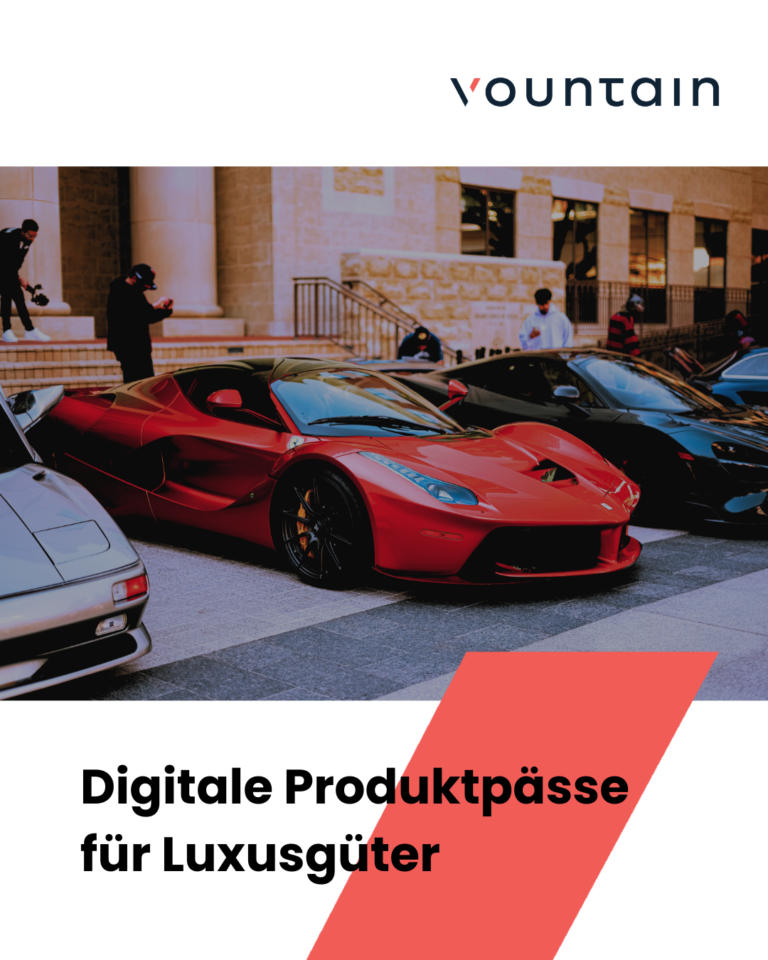
A digital product passport is the digital identity of a physical object.
It consolidates all relevant information about a product in one place – structured, traceable, and permanently accessible. Think of it as the history of a luxury good, a robust documentation:
– Where does the object come from?
– How has it changed over time?
– Who worked on it?
– What events have shaped its condition and value?
At its core, the digital product passport fulfills three functions:
1. Identification: It makes a single object uniquely distinguishable from all others.
2. Documentation: It records origin, characteristics, and history.
3. Traceability: It shows how a product has developed throughout its entire life cycle.
It’s important to understand what a digital product passport is not. It’s not a simple serial number. Not a scanned certificate. Not a loose PDF in the cloud. And not a closed manufacturer database whose contents cannot be verified.
Instead, the digital product passport acts as the single source of truth for an object. All relevant information is consolidated, continuously updated, and—depending on the configuration—stored in a verifiable manner. Changes remain visible. Additions are traceable. The history is not overwritten, but rather continued.
This distinction is crucial, especially for luxury goods whose value stems from their uniqueness and history. Because here, it’s not just about what an object is, but about why one can trust it.
The digital product passport is becoming the new standard for trust in the luxury market.
What information does a digital product passport contain?
A digital product passport thrives not on the sheer quantity of data, but on its relevance. It doesn’t include everything, but precisely what is crucial for authenticity, evaluation, and trust.
The content can generally be structured into several levels.
Static Basic Data
- Manufacturer or creator
- Period of creation
- Materials and technical specifications
- Series or identification features
This information does not change. It forms the foundation of the product’s identity.
Historical Information
- Origin and provenance
- Previous owners or institutions (if authorized)
- Documented stages in the object’s life cycle
In the luxury segment, this level is central. It tells the object’s story—not narratively, but verifiably.
Dynamic Event Data
- Maintenance and restorations
- Repairs and modifications
- Relocations or loans
- Changes in condition over time
This data reveals how responsibly an object has been handled.
Expert Reports and Evidence
A digital product passport can bundle relevant documents:
- Expert opinions and condition reports
- Scientific studies
- Certificates and insurance documents
Crucially, it’s not just the document itself that matters, but also who created it and when.
Multimedia Content
Images, videos, or scans supplement the facts:
- Detailed photos
- Comparative documentation
- Visual condition reports
Not all information needs to be publicly accessible. Modern product passports use tiered access rights. The owner decides which data is visible—and to whom. Discretion and transparency are therefore not mutually exclusive.
Why traditional proof is no longer sufficient in the luxury segment
For decades, the luxury market operated on a simple principle: trust through authority. An appraisal, a stamp, a name were often enough to confirm authenticity and value.
This model is increasingly under pressure.
Paper documents are easily lost, manipulated, and isolated. They often exist separately from the object they refer to. If they are lost, a gap remains. If they are copied, uncertainty arises. If they are passed on without context, their significance is lost.
Added to this is a structural problem: lack of transparency. Many luxury markets have grown organically over time, are small, personal, and deliberately closed off. Information is scattered among owners, appraisers, workshops, or insurance companies. There is no central, consistent overview.
With the globalization of these markets, the risk intensifies. Whether art, classic cars, or high-end watches—forgeries are becoming ever more technically precise. At the same time, objects change hands more frequently. The circle of those involved expands. The network of personal trust thins.
Traditional methods of verification reach their limits here. They are sporadic, not continuous. They capture a single moment, not the entire life cycle. And they are difficult to systematically verify or combine.
The digital product passport addresses precisely this issue. It doesn’t replace expertise, but it structures it. It makes knowledge permanently available, verifiable, and adaptable – across time, generations, and markets.
In the luxury segment, origin is not a marketing argument, but a question of proof.
Why the digital product passport is particularly relevant for luxury goods
Luxury goods differ fundamentally from consumer products. Their value arises not from interchangeability, but from uniqueness. Not from function alone, but from history, condition, and context.
This is precisely where the digital product passport unfolds its particular relevance.
Many luxury objects have exceptionally long life cycles. A mechanical watch, a historical instrument, a work of art, or a classic car doesn’t exist for years, but for decades—often centuries. Their value doesn’t develop linearly, but is driven by events: through restorations, exhibitions, changes of ownership, or historical attributions.
At the same time, these objects move in markets with high individual values. Even minor uncertainties in the documentation can have significant repercussions for price, insurability, or tradability. Provenance, condition, and history are not additional information—they are the product itself.
Furthermore, there is an emotional dimension. Luxury goods are often more than mere assets. They represent responsibility, cultural heritage, and transmission across generations. A properly documented life cycle is therefore not only economically relevant, but also culturally significant.
The digital product passport offers, for the first time, a structure that does justice to this complexity. It combines factual transparency with a long-term perspective.
What are the advantages of a digital product passport?
Tokenization without a validated digital product passport remains a financial construct without substance.
The benefits of a digital product passport become apparent throughout the entire life cycle of a luxury good.
Greater Trust and Authenticity
A digital product passport fosters trust because it is not based on a single statement, but on a verifiable history. Information is not viewed in isolation, but in context. Appraisals, condition reports, and events build upon one another and remain permanently accessible.
For buyers, this means less uncertainty. For owners, it means greater credibility. For the market, it means more stable valuation criteria.
Preserving Value and Improved Valuation
A fully documented life cycle has a stabilizing effect on value. Care, maintenance, and responsible handling become visible. Interventions are not concealed, but categorized.
This not only facilitates trading, but also:
- Insurance
- Financing
- Long-term wealth planning
Transparency thus becomes a factor in preserving value.
Simplified Transfer and Estate Planning
Transferring ownership of high-priced individual items can be complex. Heirs or new owners are often faced with fragmented documentation and decisions that are difficult to understand.
A digital product passport consolidates knowledge and responsibility. It facilitates transfers – legally, economically, and culturally. The asset remains explainable, even when personal contacts are no longer available.
Foundation for new digital business models
Ultimately, the digital product passport creates something that has been missing until now: a robust database. Only this enables further applications – such as digital ownership models, tokenized structures, and new forms of insurance or financing.
Not all of these applications are a reality today. But without structured, reliable data, none of them will work.
What role does blockchain play in the digital product passport?
Blockchain is not an end in itself for the digital product passport. It is infrastructure.
Its key advantage lies in its immutability. Once stored, information cannot be secretly overwritten or subsequently manipulated. Additions remain visible, corrections traceable. The history is recorded, not erased.
This is crucial, especially in the luxury segment. Here, speed is not the priority, but rather the ability to provide verifiable evidence over extended periods. Blockchain creates a technical framework in which data does not belong to a single party, but remains permanently verifiable.
It is also important to understand what blockchain does not mean. It does not automatically make data public. Modern systems operate with clearly defined access rights. Discretion and data protection can be combined with transparency, controlled by the owner of the object.
In this sense, blockchain is less a disruptive idea than a stable foundation. It does not replace appraisals, expertise, or market knowledge. But it ensures that all this information is permanently and reliably embedded.
Conclusion: The digital product passport as a new standard for trust
Luxury has always thrived on provenance, history, and trust. What’s changing are the requirements for verifying these credentials.
The digital product passport addresses this change not with gimmicks, but with structure. It brings order to fragmented information, makes lifecycles traceable, and reduces dependencies on individual documents or people.
For owners, this means security. For buyers, transparency. For the market, a solid foundation.
The digital product passport is not a short-term trend or a technological experiment. It is a logical evolution for markets where uniqueness, value, and responsibility are inextricably linked.
vountain: A new gold standard for the tokenization of luxury goods
When the digital product passport becomes the foundation of trust, a crucial question arises:
Who defines the quality of this standard?
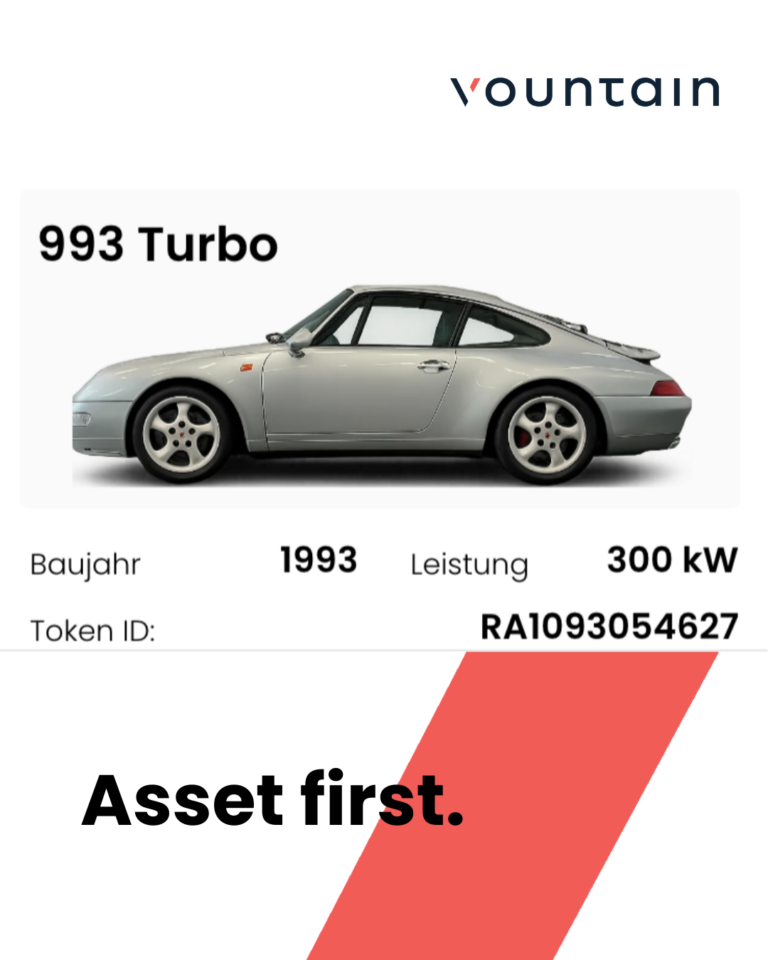
vountain addresses precisely this point. It focuses not on the rapid tradability of tokens, but on the reliability of the underlying asset. The approach follows a clear principle: Asset first. Before a luxury good is digitally represented, it must be fully understood, documented, and validated.
The digital product passport serves as the central element: It combines provenance, appraisals, condition data, and events in a consistent, updatable structure. Validated by experts, secured by blockchain, and controlled by the owner.
This approach establishes a new gold standard. Tokenization thus transforms from a buzzword into a robust foundation for preserving value, transparency, and long-term market acceptance.
vountain targets owners, collectors, foundations, and institutions that bear responsibility for exceptional assets—and want to consistently reflect this responsibility digitally.
If you would like to learn more about how a digital product passport and tokenized structures can be used effectively for your luxury goods, please feel free to contact us and let’s talk about your assets.
vountain defines tokenization not as a financial product, but as an infrastructure for authenticity.
What is a digital product passport?
What is a digital product passport?
A digital product passport is the digital identity of a physical product. It compiles all relevant information about the origin, history, condition, and events of an object and makes this traceable throughout its entire life cycle.
Why is the digital product passport particularly important for luxury goods?
Why is the digital product passport particularly important for luxury goods?
Because the value of luxury goods arises not from function, but from origin, authenticity, and history. The digital product passport makes these factors verifiable and reduces uncertainty in trade, valuation, and transfer.
How does a digital product passport differ from a certificate?
How does a digital product passport differ from a certificate?
A certificate captures a single moment. A digital product passport documents the entire lifecycle. It is updatable, verifiable, and replaces isolated documents with a consistent structure.
What role does blockchain play in the digital product passport?
What role does blockchain play in the digital product passport?
Blockchain technology ensures immutability and traceability. Once stored, information cannot be manipulated without detection. Additions remain visible, and corrections are transparent.
Is all data publicly accessible?
Is all data publicly accessible?
No. Modern digital product passports work with tiered access rights. The owner decides which information is visible to whom.
What distinguishes vountain from other tokenization approaches?
What distinguishes vountain from other tokenization approaches?
vountain follows a strict asset-first principle. Tokenization only occurs after complete documentation, validation, and structuring of the underlying luxury good. The digital product passport is the central element in this process.


